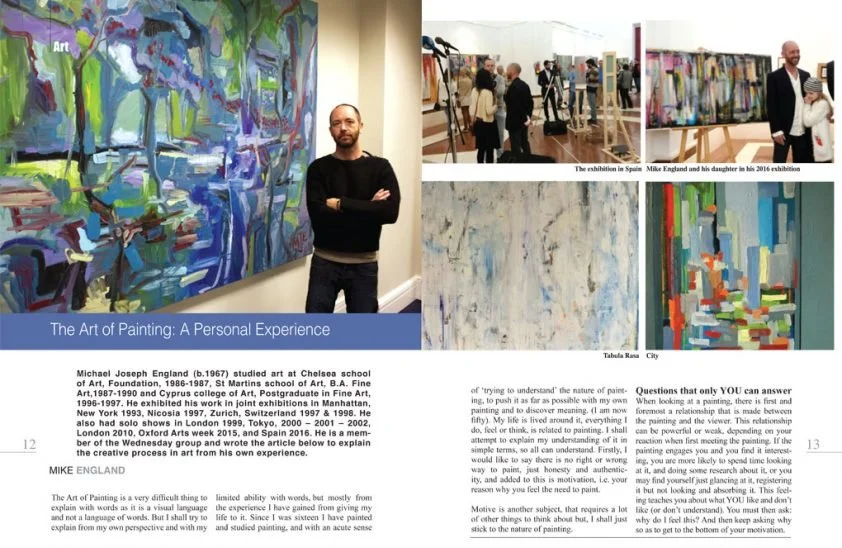
The Art of Painting.
The Art of Painting is a very difficult thing to exlpain,
But I shall try to explain: From my own perspective (experience gained from giving my life to it, since I was 16 I have painted and studied painting with a sense of ‘trying to understand’ the nature of painting, to push it as far as possible with my own painting and to discover meaning. I am now 47).
My life is lived around it, everything I do, feel or think about is related to painting.
From my own perspective I shall attempt to explain it in layman terms, so all can understand, to grasp a meaning.
Firstly I would like to say There is no right or wrong way to paint, just honesty and authenticity, and added to this is motivation, your reason why you feel the need to paint… these questions only YOU can answer… Motive is another subject, that requires a lot of other things to think about...But, I shall just stick to the nature of Painting.
There is first and foremost a relationship that is made between the painting and the viewer.
This relationship can be powerful or weak, depending on our perspective when we first meet the painting.
If the painting engages you and you find it interesting you are more likely to spend more time, either looking at it, and doing some research about it... or just glancing at it, registering it but not looking and absorbing it.
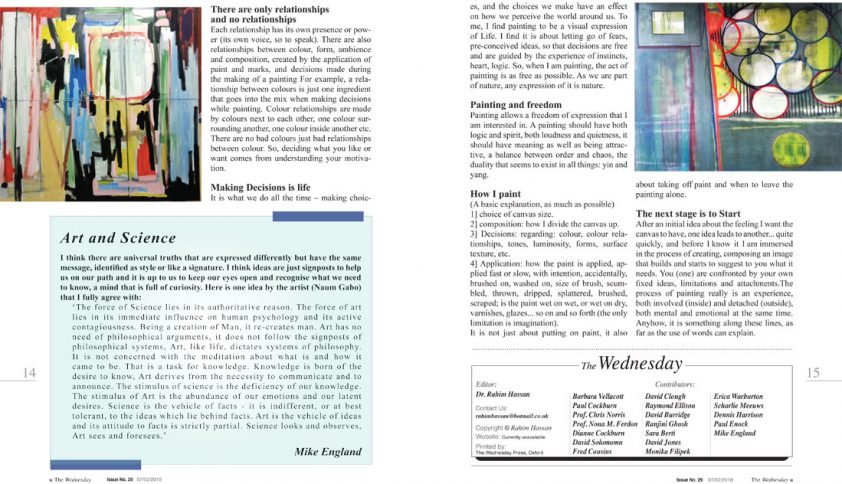
There are only good relationships and not so good relationships....
There are also relationships between Colour, Composition, Forms and Ambient, created by the application of paint and marks and Decisions made during the making of a painting
Each relationship has its own presence/ power(its own voice so to speak)
Relationship between colour is just one ingredient that goes into the mix when making decisions, while painting.
Colour relationship is made by colours next to each other, one colour surrounding another, one colour inside another etc...
Making Decision is what life is about.
To me, I find painting to be a visual expression of Life.
It is about ‘letting go’ .... of fears, preconceived ideas so that decisions are free and are guided by the instincts/heart/logic/experience ... so when painting, the painting is free...
Painting allows a freedom of expression that I am interested in.
A painting should have duality, both logic and spirit, both loudness and quietness, it should have meaning as well as being attractive.
How I paint, a basic explanation...(as much as possible)
1]choice of canvas size.
2]composition: how I divide the canvas up.
3]Decisions: re’ Colour, Colour relationships, Tone, Luminosity etc
4] Application: How the paint is applied, brushed on, dry or washed on, size of brush, scumbled, thrown, dripped splattered, brushed, scraped, is the paint wet on wet, or wet on dry, varnishes, glazes... so on and so forth… (only limited by imagination).
The next stage is to Start.
After an initial idea about the feeling I want the canvas to have, one idea leads to another... quite quickly, and before you know it you are immersed in the process of creating, composing an image that builds and starts to suggest to you what it needs.
You(one) are confronted by your own fixed ideas, limitations and attachments...
It really is an experience... both involved(inside) and detached(outside), both mental and emotional at the same time.
“something along these lines, as far as the use of words can explain”
Mike England, 11/7/15
Interview, October 2000, Shoreditch studio, London,
Talking about the new series.
Mike England’s work reflects his belief that the more you learn the less you know. “I’m into paint,” he says simply. “Paint on canvas, It’s as old as the hills.” Indeed there is nothing ‘clever’ about the paintings, no point of reference on which the viewer may hang conception, and there by feel intelligent. In place of cleverness, there is rigour; the humility in the face of this ancient medium.
Mike is a filter for his environment. He works in a small studio in East London. Through his window he tracks the changing light of a big sky, he absorbs the hub and motion of urban life. The canvasses are each a map of Mike’s quest for visual harmony. They reflect the harmony in the object world; the balance between colour, texture and line, between order and chaos, flux and stasis. Vertical stripes may recall the migrating bands of TV sets, those alternative windows through which we view the world. They may also remind us of the inherent delay of perception, of the relationships between time and distance.
Mike’s work is none referential. It aspires to pure feeling. If we can look at the paintings as we apprehend music or gaze at the sea, or watch an electric storm, then we become accessible to them. The floating blocks of colour, the soft yellows and blues and the vibrant reds, the successive layers of paint, create an ethereal quality, a sense of shifting motion.
Mike wishes to blur boundaries of perception. The eye floats across the canvas. It will not find a recognizable image, a focal point generating meaning.
This is the vocation of advertising and Mike’s work is the opposite of advertising. If advertising images are signs attached to meaning then Mike’s paintings cut images off from meaning so that they may float away like balloons, freeing the mind.
Mike England’s paintings are elusive. However, if you give them a chance they’ll tease your consciousness into a satisfying sense of harmony.
One picture may look like the outlines of banned items in an airport security X-ray; another may resemble a Welsh landscape, burgeoning with primal spongiform plants that await a dinosaur’s jaws.
In another a series of time-lapse images seem to be describing an inner dreamscape of the painter’s thoughtful psyche.
As you look from subject to subject you don’t quite know what’s what. The pictures move in and out of the figurative. Is another painting a cityscape with TV screens and warnings to jaywalkers? Or is it Mondrian’s ghost picking up his ruler and his brushes again?
“Everything is abstract”, Mike England says, gently throwing down the gauntlet to anyone who might feel challenged by his painting’s non-figurative aspect.
Mike England’s paintings penetrate the inner and reflect it in the outer. It’s quantum painting in which the artist is quietly breaking new ground. He proceeds according to his own lights and his paintings reflect that illumination.
Heathcote Williams
For me, Painting makes more sense than anything else ....
It is the closest thing to nature, almost to the point that you becomes nature itself in the act of creating.
As we are from nature, everything we do is therefore an expression of nature.
The freedom and letting go of who we think we are allows us to express ourselves creatively
visually in this case.
Painting, as in nature has its opposite poles, order and chaos.
It is the relationship between these poles that creates the harmonies, tensions and balance within the painting, regardless of subject matter.
a good painting whether figurative, landscape or abstract are all challenged with the same set of criteria's.
To know whether a painting is successful or not, without having to look at a label, price tag or stamp of approval from the so-called experts.
-You must first absorb what is in front of you, and look(not with the logic of the mind) at the painting.
-Stop thinking and try to allow thoughts and questions that may arise('whats all this about'?,' that doesn't look right'??, 'i don't understand it', 'that’s a beautiful passage'.....etc) to pass through you, don't try to answer those questions until you have absorbed the painting, allowing your eyes to roam over the painting(where ever they wants to go).
Use your mind to observe your emotional response to the painting.
Through this time spent looking/absorbing you will have collected a variety of feelings and thoughts, and this will be your starting point for that particular painting.
From this starting point, and the more you look at paintings this way, the more you will be able to start to understand what is successful as a painting and what you like in particular about certain paintings.
looking is a perspective, and the more you can expand your perspective the clearer you can see.
Mike England, 2018
Arcos Information. 15th January 2016. local paper for the town of Arcos de la Frontera, cadiz
"One thing is Art, another is the World of Art”
Mike England... Painter.
Translation by Jazmin Cuenya.
“One thing is Art, another is the World of Art”
As he doesn't speak Spanish and i don't speak English, there was a misunderstanding about our meeting. I waited for him at Jose Durans studio(at the edge of the cliff in Arcos). we had apparently arranged to meet at Mayorazgo(a bar in the Palace), but because it wasn't understood, I spent a nice time waiting, watching Jose working on some prints. I enjoy witnessing the creative process, while it's happening. I felt very comfortable among half finished paintings, prints and objects of all sorts, I was happy to wait. there was a smell of paint and turpentine that took me back to fond memories in childhood.
But well.... the interview had to be made, so I went to Mayorazgo.
Mike England, The Painter Mike England came accompanied with Jazmin Cuenya, a young, dreamy eyed Argentinian woman, who’s eyes were gently attentive during the interview.
Jazmin was going to be our translator, she was to be a bridge between our two languages.
Here is what was said..
P.E. (Pedro Seville). “can you give me your opinion about Painting in England today?”
M.E. (Mike England). In painting there are no Frontiers/ Boundry’s, Painting is global.
I distinguish between two different things, one thing is Art and the Other is the World of Art.
P.S. “ What is the difference”?
M.E. The Art world is motivated by money, Art is not, That is the difference, Art is motivated by Life, and the pursuit of trying to understand the sense of life,
P.S. “would you recognise there are different schools of painting, i.e. Venetian, Spanish, etc.... is there an English School of painting”?
M.E. Of course. There is a way to be English, and therefore a way to Paint,
All cultures have an influence on the people within them, “ Environment” to “History” have an influence, and therefore an influence on different styles, different schools of painting.
P.S. “How do you define your paintings”?
“Have you been painting for a long time”?
M.E. Since I was 16 I knew clearly that poetry(he was meant to write painting, I'm sure) was to be my life. Before that age i already had a feeling but I wasn't conscious of it, I was only a child, but from the age of 16 i knew painting would be my way.
P.S. “Alright..How would you describe your painting”?
M.E. At first sight/ impression, from the outside, it could be catalogued as Abstract, but seen from the inside, from my perspective, I think it is very clear and literal.
But if it needs to be catagorised , then we can say it is Abstract. The more I paint, the more I find it is difficult to categorise... Anyway, I guess it's like trying to define what love is.... “what is love”?
P.S. “But before painting Abstract, Did you paint a lot”?.. “Is there a long path before reaching Abstraction”?
M.E. Yes,.... There is a long way before reaching Abstraction...
(Here Mike laughs openly... jazmin explains to Pedro that Mike is not used to such rigid/direct questions... then Mike continues speaking)
… My work is about duality, between the mind and spirit,
P.S. “But painting is flesh/texture....No”?
M.E. Painting is an Expression, If I was a musician, I would express with music, probably the same ideas as i try to express with painting.
I paint to find A truth, like you Pedro when you write(apart from being a writer for a newspaper, he is also a writer/poet of his own ideas, he is a published writer), I try to express A Truth, not The Truth...
P.S. On the 8th - 23rd April this year, you have an exhibition in Arcos, in Misiricordia..... what do you expect?
M.E. Nothing... “No Expectations...No Disappointments”
(now it's Pedro that Laughs openly, he is shocked by such a clear but profound answer as he explains)
P.S. “But i suppose every Artist would like to know what people think of their work?”
M.E. I have a website, mikeengland.co.uk where people if they are interested can get an idea about the nature of my work.
“It is not my business to know what other people think”.
The Art of painting is ancient, and every generation recreates Art, reflecting themselves in the time they are living.... Basically... every generation re-invents the wheel.
P.S. “Does painting have a Magic, Tribal, Religious component?”
M.E. Yes, also everything has an influence, everything has an effect on who we are.
The knowledge of history has an influence and effect.
Our work/life is a constant decision about what to absorb and what to reject, but in order to know what to reject, you have to know how to absorb. You have to learn the rule book before you can throw it away.
P.S. “Are you a painter of the surface or of the inside?, do you paint what you see or do you paint from an idea?”
M.E. Both, even the superficial has a depth, you can't separate these two things, they both have an influence, This global reality can't be seperated.
You can't separate the Body and the mind.
Reality is both surface and depth.
A coin has two sides, it needs two sides to be a coin.
But human beings love to categorise, and will choose one over other, and will usually only see one side.
That is the real War.
P.S. “What do you think of the painting in Arcos?”
M.E .I don't know many painters here, but i think Jose Duran is unique, his work is special because his spirit is curious.
Arcos is a traditional place, a beautiful place, it has attracted and attracts many painters.
But Duran is something different than the traditional.
Of course, I don't mean to criticise.
In painting there is nothing correct or incorrect, everything has its place.
P.S. “Is there good painting and Bad painting”?
M.E. Yes, of course... as with everything.
P.S. “I understand you are going to make a series of prints for the exhibition, Is this right?”
M.E. Yes, I am having this exhibition in Misiricordia, a beautiful old chapel. It's pillars made me think of the 'stations of the cross' in churches, and this in turn made me the think of making a series of prints.
I am going to make 7 Prints as i think 7 is a magic number.
The stations of the cross were a way to teach people.
Imagry has always been a way to teach people.
P.S. “Is there anything else you would like to say that i haven't asked?”
M.E. Well... in Painting there has to be a few ingredients... Beauty, Authenticity, Aesthetics, Harmony, Balance...just to mention a few.. there are infinte other things as well to consider when composing a painting ....
It should be universal and all inclusive.
Painting should also challenge people to confront themselves(and their opinions), to question themselves.
I hope to transmit with my exhibition love and reflection... because that is what the world probably needs.
Synopsis of my words by Ai, trying to explain the nature of painting
Painting as a language beyond words
Painting is a visual language, so words can only point towards it. It lives in “the stuff in between each word”. The early-hours piece compares the painter to a jazz musician, shaman or witch doctor, working by feeling and intuition. For people unfamiliar with abstraction, your short explanation is “I make visual music.”
2. Relationships are everything
A painting is a web of relationships, and each has its own “voice”:
Painting and viewer: the first meeting can be strong or weak, and that reaction tells you something about yourself.
Colour and colour: colours next to, around or inside each other. “There are no bad colours, just bad relationships between colours.”
Colour, form, composition and atmosphere: all created by the marks and decisions made while painting.
3. Balance of opposites
A good painting holds pairs together: logic and spirit, loudness and quietness, order and chaos, meaning and attractiveness. You link this to yin and yang (the Chinese idea that opposite forces depend on and balance each other). The tension and harmony between these poles is what makes a painting work, whatever its subject.
4. Heart leads, head assists
Your focus comes from the spirit and heart. The head stays at a distance as a tool for composing and structuring. Creative energy is a “wild horse” that you follow rather than break. You aim to capture energy and life, and to reach “the most perfect visual resonance”. Letting go of fear and preconceived ideas keeps decisions free.
5. Painting as life and nature
Making decisions is what life is, and painting is a visual expression of it. Because we come from nature, anything we make is an expression of nature. In the act of painting you can almost become nature. You also describe painting as a spiritual journey that “makes more sense than anything else”.
6. How a painting is made
Your basic process has four steps:
Choose the canvas size.
Compose, meaning decide how to divide the canvas.
Decide on colour, tone (lightness or darkness), luminosity (glow) and so on.
Apply the paint. This covers fast or slow, brushed, washed, thrown, dripped, splattered or scraped, wet on wet (new paint into paint that hasn’t dried) or wet on dry, plus scumbling (dragging thin, broken paint over another layer) and glazes (thin transparent layers).
Painting is also about taking paint off and knowing when to leave it alone. Once begun, one idea leads to the next and the painting starts to tell you what it needs. It confronts you with your own fixed ideas and attachments. The experience is both inside and detached, mental and emotional.
7. Abstraction and intention
You avoid political and figurative references (pictures of recognisable things) on purpose. Abstract painting is a hard language to learn because it goes beyond the physical, and you call it a spiritual act. Every mark is intended, not accidental. The only random elements are the canvas sizes and the boards, which are found in skips or as off-cuts, and wood you will even de-nail to reuse. Buying a canvas is done by feeling.
8. The living-thing metaphor
The blank canvas is a boundaried emptiness of possibility, and the first mark is its first breath. You then guide and nurture the painting like a child. It has its own character and tests whether you can bring out its qualities honestly and purely.
9. How to look at a painting (your 2018 guidance)
Absorb first and don’t judge. Let thoughts such as “I don’t understand it” pass through without answering them.
Let your eyes roam wherever they want.
Use your mind to observe your emotional response.